

Garnet: Difference between revisions
(Created page with "'''Garnet''' is a gemstone that holds the light of the third ray. (Other gemstones of the third ray are ruby—which is also used on the sixth ray—the diamond, the [...") |
PeterDuffy (talk | contribs) (Marked this version for translation) |
||
| (2 intermediate revisions by the same user not shown) | |||
| Line 1: | Line 1: | ||
<languages /> | |||
<translate> | |||
<!--T:1--> | |||
'''Garnet''' is a gemstone that holds the light of the third ray. (Other gemstones of the third ray are [[ruby]]—which is also used on the sixth ray—the [[diamond]], the [[rose quartz]] and [[pink beryl]].) | '''Garnet''' is a gemstone that holds the light of the third ray. (Other gemstones of the third ray are [[ruby]]—which is also used on the sixth ray—the [[diamond]], the [[rose quartz]] and [[pink beryl]].) | ||
<!--T:2--> | |||
[[Paul the Venetian]], chohan of the third ray, uses these gemstones for the strengthening and purification of the blood and the heart physically, as well as the anchoring of the third ray of God’s love. These gemstones help us in developing the sensitivity of the heart, preparing us to receive the gift of discernment of Spirits. | [[Paul the Venetian]], chohan of the third ray, uses these gemstones for the strengthening and purification of the blood and the heart physically, as well as the anchoring of the third ray of God’s love. These gemstones help us in developing the sensitivity of the heart, preparing us to receive the gift of discernment of Spirits. | ||
<!--T:3--> | |||
Garnet is a beautiful stone, but it is soft. The ancients sometimes confused garnets and rubies, lumping all red stones into one designation. Garnet ranges in color from dark red to violet to orange-brown. It also comes in yellow or green. | Garnet is a beautiful stone, but it is soft. The ancients sometimes confused garnets and rubies, lumping all red stones into one designation. Garnet ranges in color from dark red to violet to orange-brown. It also comes in yellow or green. | ||
<!--T:4--> | |||
Medieval writers referred to the garnet as the carbuncle. The Hebrew name for carbuncle was ''bareketh'', meaning “flashing stone.” Eastern legends say [[Noah]] suspended a carbuncle in the Ark to diffuse light. | Medieval writers referred to the garnet as the carbuncle. The Hebrew name for carbuncle was ''bareketh'', meaning “flashing stone.” Eastern legends say [[Noah]] suspended a carbuncle in the Ark to diffuse light. | ||
<!--T:5--> | |||
Like the ruby, in medieval times garnet was said to warn its owner of approaching danger and trouble by changing its color. Amulets of garnet were worn to protect against evil and terrifying dreams and to prevent skin diseases. The garnet also has a long tradition of being used for the strengthening of the blood. | Like the ruby, in medieval times garnet was said to warn its owner of approaching danger and trouble by changing its color. Amulets of garnet were worn to protect against evil and terrifying dreams and to prevent skin diseases. The garnet also has a long tradition of being used for the strengthening of the blood. | ||
<!--T:6--> | |||
Both the ruby and the garnet are used as focuses for the Sacred Heart of [[Jesus]] and the blood of Christ. | Both the ruby and the garnet are used as focuses for the Sacred Heart of [[Jesus]] and the blood of Christ. | ||
</translate> | |||
<gallery mode="packed-hover"> | <gallery mode="packed-hover"> | ||
File:Garnet Andradite20.jpg|Garnet | File:Garnet Andradite20.jpg|<translate><!--T:7--> Garnet</translate> | ||
File:Apollonios of Athens - Ring with Portrait of a Courtier - Walters 571698 crop portrait.jpg|Ancient Greek garnet ring | File:Apollonios of Athens - Ring with Portrait of a Courtier - Walters 571698 crop portrait.jpg|<translate><!--T:8--> Ancient Greek garnet ring</translate> | ||
File:Victorian almandine garnet brooch.jpg|Victorian garnet brooch | File:Victorian almandine garnet brooch.jpg|<translate><!--T:9--> Victorian garnet brooch</translate> | ||
File:800px-AlmandinInde.jpg|Garnet from Jaipur, India | File:800px-AlmandinInde.jpg|<translate><!--T:10--> Garnet from Jaipur, India</translate> | ||
</gallery> | </gallery> | ||
== Sources == | <translate> | ||
== Sources == <!--T:11--> | |||
<!--T:12--> | |||
Lectures by Elizabeth Clare Prophet October 2 & 18, 1987, February 11, 12 & 22, 1988. | Lectures by Elizabeth Clare Prophet October 2 & 18, 1987, February 11, 12 & 22, 1988. | ||
</translate> | |||
[[Category:Gemstones]] | [[Category:Gemstones{{#translation:}}]] | ||
Latest revision as of 05:48, 31 December 2025
Garnet is a gemstone that holds the light of the third ray. (Other gemstones of the third ray are ruby—which is also used on the sixth ray—the diamond, the rose quartz and pink beryl.)
Paul the Venetian, chohan of the third ray, uses these gemstones for the strengthening and purification of the blood and the heart physically, as well as the anchoring of the third ray of God’s love. These gemstones help us in developing the sensitivity of the heart, preparing us to receive the gift of discernment of Spirits.
Garnet is a beautiful stone, but it is soft. The ancients sometimes confused garnets and rubies, lumping all red stones into one designation. Garnet ranges in color from dark red to violet to orange-brown. It also comes in yellow or green.
Medieval writers referred to the garnet as the carbuncle. The Hebrew name for carbuncle was bareketh, meaning “flashing stone.” Eastern legends say Noah suspended a carbuncle in the Ark to diffuse light.
Like the ruby, in medieval times garnet was said to warn its owner of approaching danger and trouble by changing its color. Amulets of garnet were worn to protect against evil and terrifying dreams and to prevent skin diseases. The garnet also has a long tradition of being used for the strengthening of the blood.
Both the ruby and the garnet are used as focuses for the Sacred Heart of Jesus and the blood of Christ.
-

Garnet
-

Ancient Greek garnet ring
-

Victorian garnet brooch
-
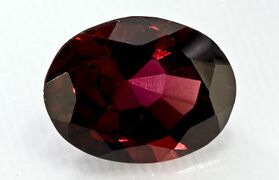
Garnet from Jaipur, India


Sources
Lectures by Elizabeth Clare Prophet October 2 & 18, 1987, February 11, 12 & 22, 1988.